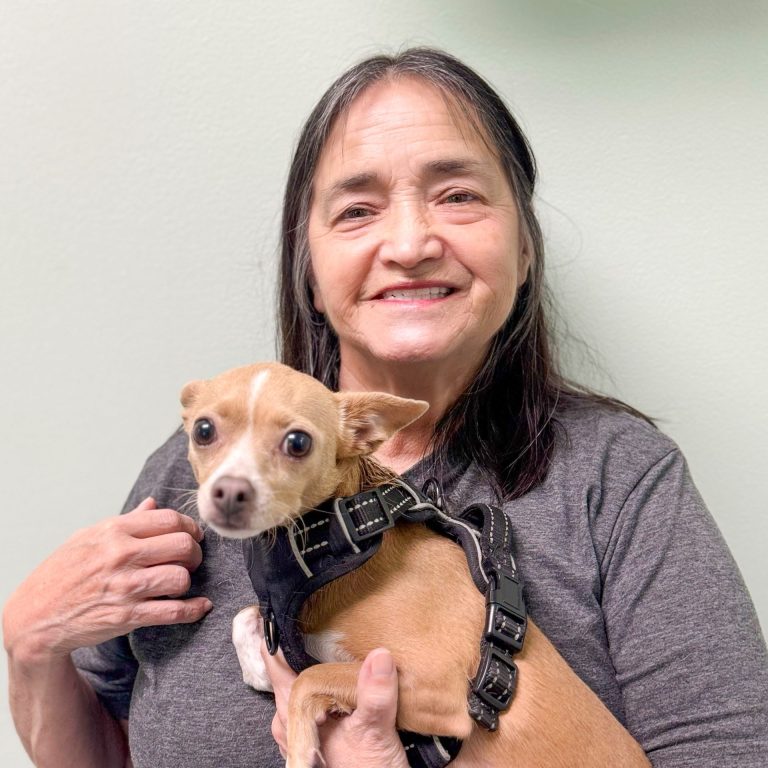
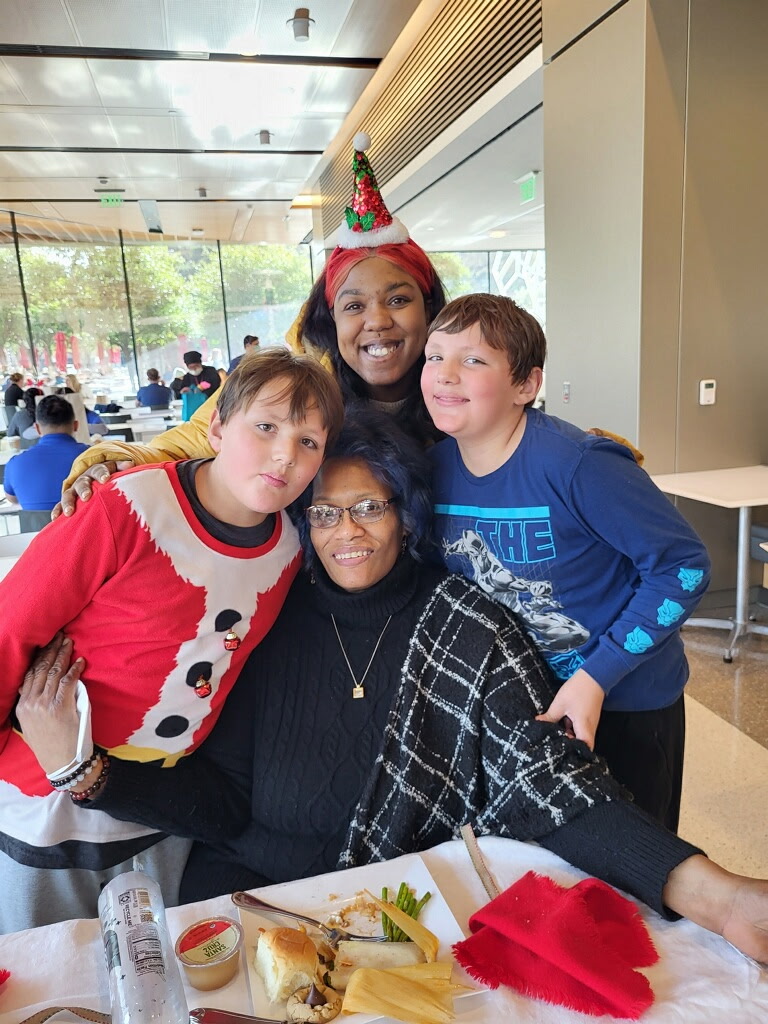
After receiving support herself, Ms. Charlotte found purpose helping thousands of community members access food, resources, and human connection.
By: Ms. Charlotte, Downtown Palo Alto Food Closet Manager
People call this place the “Gourmet Food Closet,” and I understand why. When folks come here, we don’t just hand them a bag and say, “Good luck.” We let people choose. We let them pick what actually works for their body, their culture, their health, their situation. This matters more than people realize.
I’m Ms. Charlotte, and I’ve been part of this food closet since 2016. Before I came to help, I came here because I needed help, and because helping other people has long been who I am.
Back then, I wasn’t in a good way health-wise. My immune system was shot, and I couldn’t do some of the work other people were doing for Downtown Streets Team. I was honest about it. I said, “I can’t do that. There’s no way.” And that’s when I was told about the Food Closet. They said, “There’s a position here. You don’t have to walk far. Everything’s right here.” I remember waiting two months to get in. Two months is a long time when you’re trying to hold it together. But Eileen Richardson (Executive Director of Peninsula Healthcare Connection, former Executive Director of Downtown Streets Team) made it happen. They opened a position for me, and I started volunteering around April, right around my birthday.
And I’ll tell you this: it helped save me.
When you’re sick a lot, people don’t understand what that does to your mind. You can end up becoming what they call a “frequent flyer,” in and out of the hospital all the time. Volunteering here gave me something else to focus on. It took my mind off what I was going through. It reminded me I still had purpose. I’ve always been a giver. Helping people is second nature to me, so this work felt like coming back to myself.
Food has always been part of my story. My parents had a restaurant when I was younger. My dad was a chef. My mom cooked, worked at the bank, and even did modeling, she stayed busy. But no matter what, my mother never turned her back on anyone who needed help. We always had somebody in the house. Somebody who needed a hand, someone getting back on their feet, someone trying to find work. That’s how I was raised. So when I got to the Food Closet, working with food and working with people, it made sense to me. It felt familiar. It felt right.
Before I was volunteering here, I was also coming here for food.
I was unhoused. People call it “couch surfing” like it’s something cute, but it’s not your place. You can only stay so long. I had a housing voucher, but it didn’t match what rent cost. I was going from place to place, trying to find stability, trying to find my footing. And next thing I know, five years passed. Five years. People don’t understand how folks lose track of time until you live it. You’re not living day-to-day like everyone else. You’re surviving day-to-day. That’s different. You blink and time is gone.
My health got worse. Stress will do that. Being unsettled will do that. I couldn’t find a doctor who could really treat me. I needed a specialist. Someone told me, “Go to Downtown Streets Team. They can help you.” So I did. They helped me find care. They took my health seriously. They got me connected. They even helped get me to appointments, surgery after surgery. If I needed a break to heal, they let me heal. They understood something people forget: you have to put the oxygen mask on yourself first. You can’t help anybody if you’re falling apart.
That’s how I learned what true care looks like.
Then one day I was waiting for a meeting and I saw people gathering outside, and I asked what was going on. Someone said, “That’s the Food Closet. You can get food.” I walked right up to the front desk. I asked questions. I signed up. And that day forward, the Food Closet helped me stay nourished.
At the time I was vegan, and I had a lot of allergies. I remember noticing something right away: nobody forced food on me that I couldn’t use. I could pick and choose per shelf. That alone is dignity. That alone is health. Some people don’t qualify for food stamps, like I didn’t, and grocery costs don’t care about your situation. A can of soup can be five dollars. People don’t have five dollars for soup when rent and gas and medicine are eating up everything. So this place becomes the difference between making it and not making it.
That’s why I’m so grateful PHC picked us up. People were scared. They were genuinely worried about what would happen if we closed. Some people say, “There are other food pantries.” And yes, there are, but they don’t do what we do. We are community-based and we are human about it. We have socks. We have toiletries. We have blankets. Sometimes we have clothes and we didn’t always, but when donations started coming and unhoused folks were asking, “Do you have something clean? I’ve been in the same clothes for days,” I wasn’t going to turn my back on that. I tell people, if you’re donating, make sure it’s clean. We’re going to respect people. Always.
A typical day here? Busy. Always.
We have slow days, like when it’s raining and folks can’t get out, but even on a slow day we can see 68, 69 people. Other days we hit the 90s and 100s like it’s nothing. We’re seeing more families now, not just single adults. People are coming in with kids, with elders, with medical diets. We do our best to meet people where they are. We have folks who are vegan, folks who are diabetic, folks who need low sodium, folks who need kosher, folks who don’t eat pork. I tell volunteers: do not play with people’s food. Respect their culture. Respect their body. Respect their beliefs. If you can’t do that, you don’t belong behind these shelves.
This place is held up by community. Second Harvest helps us. We get support from markets and stores and I appreciate all of it. But the truth is, you can’t run an operation on food alone. You need dollars too. The overhead is real. It’s about $55,000 to $60,000 a year to keep things running — rent, supplies, the incidentals you don’t think about until you’re the one buying them. Donations keep the lights on. They keep the doors open. They keep this place alive.
And during COVID, let me tell you what happened: everything shut down, and we were the only food pantry open in Santa Clara County. The only one. People were sheltering in place, and we were still here. I doubled masked. I doubled gloved. My family came out. They volunteered. They delivered food all the way into San Jose. We were delivering until 10 p.m., sometimes almost 11 p.m. We stayed open late because people needed us. That wasn’t a “nice thing.” That was survival for families.
People ask me why I keep coming back. It’s simple. I love people. I love my community. I believe if there’s a will, I’m going to make a way…and there’s always a will.
This work means the world to me because at the end of the day, someone is going to eat. Someone is going to feel a little safer. Someone is going to feel seen. Sometimes what they need isn’t even food, it’s help reading a letter, it’s a clean pair of socks, it’s someone to listen without judging. Sometimes people walk in carrying the weight of the world, and if they can walk out with a smile, even for a minute, then we did something important.
I’ve had people come in ashamed, and I won’t let them leave that way.
I’ll never forget a man who came with his pregnant wife and their two kids. He was crying. He said, “I never thought I’d come to a food pantry.” I told him, “You’re not begging. You’re taking care of your family. Hold your head up. What you’re teaching your kids is that their dad loves them enough to do whatever it takes.” He walked out feeling proud. I’ve never seen him again, but I’ll remember that moment forever.
I’ve learned a lot here. I’ve learned people are one paycheck away from losing everything. I’ve learned you cannot judge someone because they look dirty or tired or rough. People have hearts. People have stories. People have trauma. People have dignity. Sometimes they just need the roller coaster to stop for a minute so they can find themselves again. They need someone to see the real them, not just what life has put on the outside of them.
I don’t see races, creeds, color. I see people. I judge you by your character and your actions. And I have zero tolerance for anyone bullying anyone in this space. This is a place of care. A place of respect. A place of safety.
If someone is thinking about volunteering, I’m going to tell you the truth: it looks easy, but it’s not just handing out food. You’re meeting people on their worst days sometimes. Some folks climbed out of a warm bed and some folks climbed off cardboard. You have to be able to handle what comes through that door. You have to have heart. You have to have patience. You have to be able to step aside if you’re overwhelmed, and you have to be willing to come back and try again. Because the whole point is: we treat people how we want to be treated. Period.
When I think about the year ahead, what gives me hope is this: our doors aren’t shutting. PHC stepped in, and the community keeps stepping in. We run on donations, and people keep showing up with love. That’s what keeps me going. That’s what keeps us afloat.
And I plan on being here. I plan on going nowhere.
Because this place is a lifeline.